
Free Printable Counting Activities for Kids
Are you looking for free printable counting activities for preschool and kindergarten? These math printables will make differentiation so easy!

Free Counting Activities for Preschool and Kindergarten
These free counting activities help preschool and kindergarten kids learn to count objects, recognize numbers and count all the way to 120. I've sorted more than 100 hands-on printables by skill, so you can quickly find what you need. They're a big part of my math activities for preschool and kindergarten, and they work well alongside my number sense activities.
Every activity on this page is a free printable. Most are low prep: print, grab a dice or a few counters, and you're ready to go!
What Are Counting Activities?
Counting activities are hands-on games and printables that help young children learn to count. Good ones go beyond saying numbers in order. They teach kids to touch and count each object once, to know that the last number they say tells "how many," and to match quantities with written numbers.
Kids learn these skills in a fairly predictable order.
Every child moves at their own pace, so treat the ages as a loose guide.
Free Counting Activities by Skill
Pick the skill your child is working on, then choose a theme they'll love. Each link opens the full post with the free printable.
1. Count and cover mats
Count and cover mats are the best place to start. Kids count the objects in a picture, then cover the matching number with a counter. Counting mats add hands-on practice: kids place the right number of manipulatives on each mat as they count.


2. Counting mats and hands-on counting games


3. Book-based counting activities


4. Number Towers (Cardinality)
Number towers show kids that each number stands for an amount. Kids build a tower of cubes to match each number, then compare which towers are taller and which are shorter. It's a simple way to see that 7 is more than 3.


Recognize Numbers 1 to 20
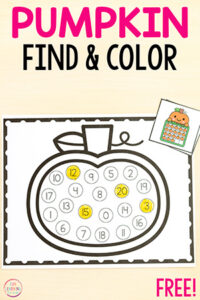
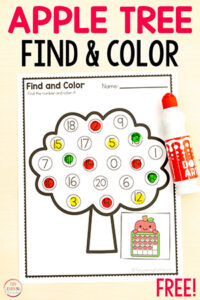
Find and color sheets ask kids to find every copy of a number in a busy picture and color it. Matching activities and clip cards connect a written number to a set of objects. These are great for quiet independent practice.
5. Find and color the number


6. Number matching and cover-up mats


7. Roll and Cover the Number (Subitizing and Number Recognition)
In roll and cover games, kids roll a dice, count or recognize the dots, and cover that number on the mat. Over time they stop counting each dot and just know the amount, which is called subitizing.


8. Count the Room Activities (Counting with Movement)
Count the room gets kids up and moving. Hide picture cards around the room, and kids hunt for each one, count the pictures and record the number on their sheet. It's a favorite for wiggly learners.


9. Write Numbers 0 to 20
Number formation cards and worksheets show kids where to start each number and which way to go. Pair them with a counting task so kids connect the number they write with the amount it stands for.


10. Count On with Number Lines
Number line games teach kids to count forward from any number instead of starting at 1. That's the first step toward adding in their heads.


11. Making Ten and Teen Numbers
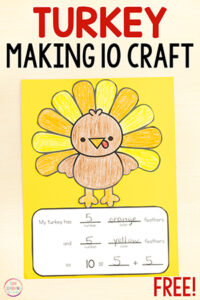
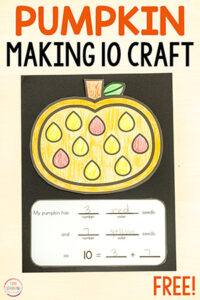
Kindergarteners learn that 14 is ten and four more. Make ten activities and teen number games help kids see the ten inside every teen number.



12. Count to 100 and 120
Kindergarteners learn that 14 is ten and four more. Make ten activities and teen number games help kids see the ten inside every teen number.


13. Digital Counting Activities
These digital activities are a good fit for computer centers, whole-group practice on a smart board or learning at home.


Materials You'll Need
As an Amazon Associate I earn from qualifying purchases.
Most of these counting activities are easy to prepare and only need a few simple supplies.
You will need:
- Printed counting mats, game boards or worksheets
- One dice (a foam dice keeps the noise down)
- Counters or linking cubes
- Crayons, markers or dot markers
To make counting practice even more exciting, add some fun manipulatives:
- Themed mini erasers
- Pom poms and tongs
- Bingo chips
- Plastic counting bears
- Pony beads and pipe cleaners
- Clothespins
Swapping in new seasonal manipulatives is an easy way to make the same activity feel brand new.
How to Teach Counting in a Fun Way
Kids learn to count best when they move, touch and play. Here's what works in my classroom and at home:
- Count real things every day. Count stairs, snacks, toys or claps. Short, frequent practice beats one long lesson.
- Touch and move each object. Have kids slide each counter to the side as they count it. This keeps them from skipping objects or counting one twice.
- Ask "How many?" at the end. If a child counts to 7 and then has to count again to answer, they're still working on cardinality. Number towers and counting mats help.
- Start small, then stretch. Master 1 to 5 before 1 to 10, and 1 to 10 before 1 to 20.
- Use dice and dot patterns. Roll and cover games build subitizing, so kids can see small amounts without counting.
- Add movement. Count the room and hopping along a number line help kids stay focused.
- Keep it playful. Pick a theme your child loves, like dinosaurs, pirates or unicorns. A quick game is more effective than a frustrating worksheet.
Common counting mistakes to watch for
- Skipping or double-counting objects: slow down and move each object as it's counted.
- Mixing up 6 and 9, or 12 and 21: practice with find and color sheets and number formation cards.
- Getting stuck at the teens: practice the tricky words eleven, twelve and thirteen, and show teens as ten and some more.
- Losing track after 29, 39 or 49: count with a 100 chart so kids can see what comes next.
Tips for Using Counting Activities in the Classroom or at Home
- Math centers: put one counting activity in each center and rotate the themes with the seasons.
- Small groups: use count and cover mats to quickly see which kids have one-to-one correspondence.
- Partner play: roll and cover games turn into a race when two kids share one board.
- Morning tubs: counting mats and number towers make great quiet, independent starters.
- Make it last: laminate cards, and laminate mats or slip them into sheet protectors so kids can use dry erase markers again and again.
Whether your students are just starting to count to 5 or racing to 120, these free counting activities make number practice something kids look forward!